1. A shortage of skilled workers in manufacturing industries
Finding candidates with the right qualifications is becoming increasingly difficult. Unfortunately, we see this trend regardless of the industry. For example:
- Automotive — needs workers with strong technical skills who can handle modern assembly lines.
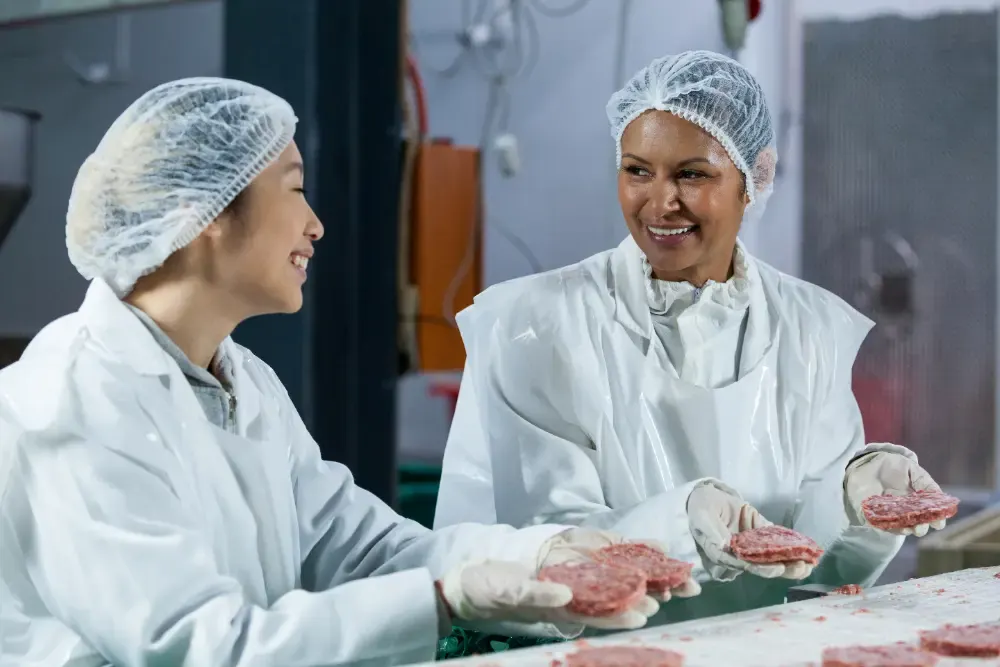
- Food industry — requires precision and the ability to work to strict hygiene standards. Production conditions can also be a challenge. In the meat industry, for example — our speciality — low temperatures in the plants can be a problem, so it is important to understand the needs not only of the business but also of the workers.
- Pharmaceuticals — the nature of production requires not only technical skills but also knowledge of quality standards, especially in drug manufacturing.
According to a ManpowerGroup report, as many as 54% of employers in the manufacturing sector struggle to find suitable workers for key positions.
Verifying candidates’ technical and practical skills
Recruiting for production roles requires particular attention to candidates’ real technical skills. Traditional interviews are often not enough, so many companies use:
- Practical tests — e.g. in the automotive industry, where workers must demonstrate manual skills and the ability to operate machines.
- Trial periods — common in industry and food production, so the employer can see how a candidate copes in real working conditions.
Without thorough verification of these skills, companies may hire people who do not meet expectations, which leads to the cost of recruiting again.
2. High turnover among production workers
Production jobs are often characterised by high staff turnover. This is one of the biggest challenges in the industry, as frequent staff changes hurt operational stability, team morale and production efficiency. High turnover can result from various factors that are specific to manufacturing:
- Physical nature of the work — production work can be monotonous and physically demanding. Many workers leave when, after a while, they do not feel at home in this environment or get tired of shift work. This is especially visible in heavy industry, textile production and food processing, where the intensity of work can lead to burnout.
- No development opportunities — in many production roles promotion prospects are limited, which lowers engagement. Without development and promotion paths, these workers often look for jobs in other industries where they can build their skills and gain new competencies.
- Irregular hours and shift work — production often runs in shifts, which can be hard to accept for people who prefer a fixed schedule. Night work or long shifts do not suit everyone and are particularly tough for people with families and other responsibilities. Industries such as food, chemicals and pharmaceuticals require continuous production, so finding people willing to work shifts can be a challenge.
Why is high turnover a problem?
High turnover in production roles can cause:
- Higher recruitment and training costs — every new employee needs onboarding and training, which means extra expenditure.
- Lower production efficiency — constant staff changes reduce efficiency, as new workers need time to adapt and learn.
- Quality problems — high turnover increases the risk of mistakes and lower production quality, as new workers may not yet be fully familiar with the processes.
- Lower team morale — permanent staff feel the negative effects of turnover when they have to train new colleagues again and again and adapt to their level.
3. Location of production plants — organising accommodation and transport
Many production plants are located on the outskirts of cities or in smaller towns, far from large urban areas. Such locations create logistical challenges for both workers and employers, who need to provide convenient commuting and accommodation. Manufacturing companies therefore face logistical problems:
- No public transport — when plants are in hard-to-reach areas, public transport is often missing or limited, making the daily commute much harder. In that case, company transport needs to be organised to get workers to work smoothly and regularly.
- Worker accommodation — if the plant is far from larger towns, companies often have to provide accommodation near the workplace. For workers from distant regions and for foreign workers, accommodation close to the plant is a big convenience that makes the job more attractive. Companies that provide it can count on more interest in their offers, especially from people looking for stability and comfort.
- Organising transport around shifts — production often runs in shifts, so transport is needed at unusual hours, including at night and early in the morning. Companies have to adjust transport schedules to shift patterns, which means extra costs and logistical coordination.
Providing transport and accommodation can be key to attracting the right candidates to such locations, but it brings additional challenges for companies.
4. Matching candidates to the industry and company culture
Every production company has its own way of working, pace and organisational culture. Matching a candidate to the industry and to the company culture is extremely important, especially in manufacturing. Industries such as food, pharmaceuticals and automotive have unique requirements — from strict quality and safety standards to shift work. Candidates must therefore show not only the right technical skills but also a readiness to work in specific conditions, such as high intensity or close teamwork. Cultural fit also affects motivation and employment stability — people who understand the company’s values and rules are more likely to stay longer, which reduces turnover and improves team efficiency. When recruiting for production roles, besides technical qualifications, the following are important:
- Teamwork skills.
- Discipline and punctuality.
- Compliance with safety standards.
- Perseverance and the ability to work under pressure.
- Motivation and willingness to work irregular hours.
Employers should remember that even the most technically skilled candidate may not fit into the team if they cannot find their place in the company’s particular work culture.
5. Hiring foreign workers — formal and legal challenges
The manufacturing industry is increasingly hiring foreign nationals. One of the challenges is legalising the stay and employment of workers from abroad and giving them proper support on site. It is an additional process that requires time and coordination. The employer must take care of:
- Legalising residence and work — which often involves a lengthy administrative procedure.
- Support with settling in — foreign workers need help with language, cultural and formal matters (e.g. accommodation, organising daily life, adjusting to new conditions).
According to Statistics Poland (GUS) data for 2022, the number of foreigners legally employed in Poland’s manufacturing sector grew by 35% compared with the previous year, showing the growing role of foreign workers in this sector.
How can Alimat Group help?
Working with a recruitment agency such as Alimat Group can significantly streamline recruitment for production roles. We offer:
- Access to qualified candidates — we have an extensive pool of workers from various industries, from Poland and abroad. We fill staffing gaps quickly.
- Comprehensive skills verification — we run tests and check candidates’ technical skills. We recommend proven candidates.
- Efficient organisation of the whole logistics process — we take care of transport and comfortable accommodation. Our coordinators, team leaders and managers look after the workers.
- Support with legalising the stay and employment of foreign nationals — we handle the full formal and legal process, from registration to accommodation.
- Lower staff turnover — we help you hire stable employees who fit your company culture. We look after your business while caring for the workers. That is how we build valuable relationships and effective teams!